

Key takeaways
- Find a beginner telescope that shows the Moon and planets clearly. Compare five scopes for aperture, mount, and ease of use before you buy one.
- Top Pick: Celestron AstroMaster 70AZ
- Runner-up: Gskyer AZ70400
- Also consider: Celestron Travel Scope 70
A first telescope should make the Moon feel close enough to touch, and it should set up in minutes on a clear evening. The right beginner scope shows craters, the rings of Saturn, and the bright bands of Jupiter without demanding a degree in astronomy or a dedicated observatory. The wrong one wobbles, frustrates, and ends up gathering dust in a closet. This guide compares five telescopes that suit people who are new to the night sky.
As an Amazon Associate, we earn from qualifying purchases.
Quick Answer
For most beginners, the Celestron AstroMaster 70AZ is the safest first scope, with a long 900 mm tube that gives clean, steady views of the Moon and planets. The Gskyer AZ70400 is the best budget family kit, the Celestron Travel Scope 70 is the easiest to carry, and the two equatorial reflectors below suit people who want brighter deep-sky views and will learn a mount.
How to Choose a Beginner Telescope
Aperture decides how much light a telescope gathers, and light decides what you can see. A 70 mm lens shows the Moon in fine detail and reveals the rings of Saturn and the bright moons of Jupiter. A 127 mm or 130 mm mirror gathers far more light, so fainter clusters and nebulae become visible, though the scope gets heavier. Do not chase the biggest aperture if the scope is too heavy to take outside often.
Focal length shapes the view. A long focal length, such as 900 mm, gives higher magnification and suits planets. A short one, such as 400 mm, gives a wider field and suits sweeping views of the Milky Way and large clusters. Focal ratio, written as f/5 or f/13, sums up the same trade-off: a lower number means a wider, brighter field, while a higher number means a narrower, steadier planetary view.
The mount matters as much as the optics. An alt-azimuth mount moves up, down, left, and right, which feels natural and sets up in seconds. An equatorial mount tilts to match the spin of the Earth, so one slow-motion knob keeps a target centred, but it takes an evening or two to learn. Beginners who want to observe right away should pick an alt-azimuth mount; people who plan long sessions should consider an equatorial one.
Eyepieces set the magnification. A 20 mm eyepiece gives a low, wide view for finding targets, while a 10 mm eyepiece doubles it for closer looks at the Moon and planets. A Barlow lens multiplies it again, but advertised maximum magnifications are ceilings, not everyday settings. A useful rule: a scope performs best below about twice its aperture in millimetres.
Weight and storage decide how often the scope gets used. A scope that packs into a backpack or a carry bag travels to dark skies, while a heavy equatorial reflector stays near the house. Finally, no beginner scope shows the colourful photographs found in astronomy books; deep-sky objects appear as soft grey glows.
Celestron AstroMaster 70AZ

The AstroMaster 70AZ is the classic first refractor, and its long tube is the reason it works so well for beginners. With a 900 mm focal length and a focal ratio of f/13, it delivers steady, high-contrast views of the Moon and planets, with very little of the false colour that troubles shorter refractors. The Moon shows craters and mountain shadows in fine detail, and Saturn’s rings and Jupiter’s moons are easy targets on a clear night.
Setup is simple. The tripod arrives pre-assembled, the red dot finder helps aim the tube, and the two included Kellner eyepieces cover low and high magnification.
The trade-offs are honest. The long tube is awkward to carry and needs storage space. There are no slow-motion controls, so tracking a planet at high magnification means nudging the tube by hand. Deep-sky objects stay faint, since a 70 mm lens gathers limited light.
Specs
- Aperture: 70 mm refractor, fully coated glass optics
- Focal length: 900 mm, focal ratio f/13
- Mount: manual alt-azimuth with pan handle
- Eyepieces: 20 mm and 10 mm Kellner
- Finderscope: StarPointer red dot finder
- Accessories: erect image diagonal, pre-assembled tripod, astronomy software
- Warranty: 2 years
- ASIN: B000MLHMAS
Gskyer AZ70400

The Gskyer AZ70400 is the lowest-cost way into the hobby in this guide, and it is built for families. The kit includes a carry bag, a phone adapter, a wireless remote, two eyepieces, and a 3x Barlow lens, so a family can set up on a driveway and photograph the Moon through the eyepiece on the first night. The 70 mm aperture and 400 mm focal length give a wide, bright field for the Moon, bright clusters, and the planets at low power.
The alt-azimuth mount is light and simple, and the whole kit is light enough for one person to carry. The short focal length finds targets quickly, which matters when children are waiting. Planetary detail is softer than the AstroMaster above, and the advertised 120x maximum is a ceiling, not an everyday setting.
Confirm the listing is the AZ70400 kit.
Specs
- Aperture: 70 mm refractor, fully multi-coated optics
- Focal length: 400 mm, focal ratio f/5.7
- Mount: manual alt-azimuth
- Eyepieces: 25 mm and 10 mm, plus 3x Barlow lens
- Accessories: carry bag, phone adapter, wireless remote, tripod
- Maximum advertised magnification: 120x
- ASIN: B081RJ8DW1
Celestron Travel Scope 70

The Travel Scope 70 exists for one reason: it goes anywhere. The whole kit packs into a canvas backpack, including the scope, the tripod, and two eyepieces, and the total weight stays under four pounds. The 70 mm aperture and 400 mm focal length give bright, wide views of the Moon and the brightest planets, and the mount sets up in minutes.
The short tube trades planetary sharpness for portability. Views of Saturn and Jupiter are smaller and softer than the AstroMaster 70AZ gives, and the light tripod needs a steady hand at higher magnification. Note the model numbers: this pick is the original Travel Scope 70, model 21035; the 70DX is a different listing. Match the model number before ordering.
Specs
- Aperture: 70 mm refractor, fully coated glass optics
- Focal length: 400 mm, focal ratio f/5.7
- Mount: manual alt-azimuth with pan handle
- Eyepieces: 20 mm and 10 mm
- Accessories: tripod, backpack, astronomy software
- Weight: under 4 pounds including tripod
- Model number: 21035
- ASIN: B001TI9Y2M
Celestron PowerSeeker 127EQ
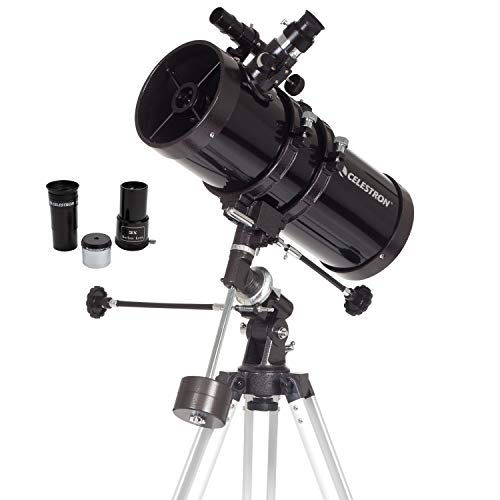
The PowerSeeker 127EQ is the step up for beginners who want real light-gathering power. Its 127 mm Newtonian reflector collects far more light than any 70 mm lens, so the Moon shows fine detail, Jupiter shows cloud bands, and bright deep-sky objects such as the Orion Nebula and the Andromeda Galaxy become visible as soft, glowing shapes.
The mount is also the main learning curve. Setting up an equatorial mount takes patience on the first few evenings, and the short 1000 mm tube uses a spherical primary mirror with a corrector lens in the focuser, which makes collimation trickier than a standard reflector. The advertised maximum of 300x is not a realistic everyday setting; the scope performs best well below that number.
Specs
- Aperture: 127 mm Newtonian reflector
- Focal length: 1000 mm, focal ratio f/7.9
- Mount: manual German equatorial with slow-motion controls
- Eyepieces: 20 mm and 4 mm, plus 3x Barlow lens
- Finderscope: 5×24
- Accessories: aluminium tripod, accessory tray, astronomy software
- Model number: 21049-CGL
- ASIN: B0007UQNKY
Gskyer 130EQ
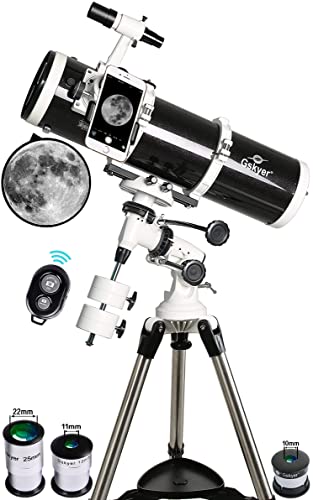
The Gskyer 130EQ pairs the largest aperture in this guide with a German equatorial mount, and it is the best pick for a beginner who wants deep-sky viewing on a moderate budget. The 130 mm mirror and 650 mm focal length gather enough light for bright clusters, nebulae, and galaxies, while the f/5 focal ratio keeps the field wide enough to find targets without frustration.
The equatorial mount needs the same learning time as the PowerSeeker above, and the scope is heavier than the 70 mm refractors, so it suits a garden or a short drive rather than a long hike. Confirm the listing is live before ordering, since one recent check showed thin stock.
Specs
- Aperture: 130 mm Newtonian reflector, all-glass optics
- Focal length: 650 mm, focal ratio f/5
- Mount: German equatorial
- Eyepieces: three, giving 26x, 65x, and 130x, plus Barlow lens
- Focuser: rack-and-pinion
- Warranty: 1 year
- Model number: EQ-130
- ASIN: B083NPL73W
Who Should Skip a Beginner Telescope
A beginner telescope is the wrong purchase for a few people. Anyone who mainly wants to photograph deep-sky objects should look at dedicated astrophotography gear instead; these scopes are built for visual observing, not long exposures. People who live under bright city lights and never travel to darker skies will see the Moon and planets well, but faint deep-sky objects will stay hidden, so binoculars may serve them better.
Anyone who expects the colourful images seen in astronomy books should pause as well. Through the eyepiece, nebulae and galaxies appear as soft grey shapes, and that is the honest view every visual observer gets. A scope also needs storage space and a few clear evenings a month to earn its place; if the plan is to observe once a year, a local astronomy club night is the better first step. Finally, people who only want daytime nature viewing should pick a spotting scope or binoculars, which are built for that job.
FAQ
Can a beginner telescope show Saturn’s rings?
Yes. A 70 mm refractor shows Saturn’s rings clearly on a steady night, and the 127 mm and 130 mm reflectors show them with more detail. The rings look small and sharp, and the best views come on calm, clear evenings.
Is a bigger aperture always better?
Mostly, but not always. A bigger aperture gathers more light and shows fainter objects, yet it also means a heavier tube, a sturdier mount, and more effort to carry outside. A 70 mm scope used every clear weekend beats a 130 mm scope that stays in a closet.
Do I need an equatorial mount as a beginner?
No. An alt-azimuth mount is easier to set up and feels natural, since it moves up, down, left, and right. An equatorial mount tracks targets with one knob once aligned, which helps during long sessions, but it takes a few evenings to learn. Begin with an alt-azimuth mount unless you know you want long sessions.
Can I use a telescope in the city?
Yes, for the Moon and the planets. Bright objects cut through city light well, and the Moon looks superb even from a balcony. Faint deep-sky objects suffer under city glow, so plan trips to darker skies if galaxies and nebulae are the goal.
Final Verdict
The Celestron AstroMaster 70AZ is the pick for most beginners, thanks to its long tube, steady planetary views, and simple setup. The Gskyer AZ70400 is the best family kit on a tight budget, and the Celestron Travel Scope 70 is the one to carry anywhere. People who want brighter deep-sky views and are willing to learn a mount should choose between the PowerSeeker 127EQ and the Gskyer 130EQ, with the 130EQ offering the most light for the effort.
More from Amazon
Programs that pair well with the guide above. Offers and eligibility are set by Amazon and may change.
Free shipping on eligible items, Prime Video and more. Eligible new members can start with a free trial.
Start a Prime free trialAudiobooks and podcasts to listen to on the go. Eligible new members can start with a free trial.
Try Audible freeAd-free music streaming. Eligible new subscribers can start with a free trial.
Try Music Unlimited freeA free business account with business pricing and bulk-buying tools for work, shop or home office.
Create a business accountAs an Amazon Associate we earn from qualifying purchases.



Write Your Review
No reviews yet. Be the first to share your experience!