

Key takeaways
- Looking for the best guitar pedals for beginners? We compare five tuner, overdrive, distortion, delay, and reverb pedals that are simple to learn on.
- Top Pick: BOSS DS-1 Distortion
- Runner-up: BOSS SD-1 Super Overdrive
- Also consider: BOSS TU-3 Chromatic Tuner
A first pedalboard does not need to be large. It needs one pedal that makes practice more fun, one that keeps the guitar in tune, and one or two that show what effects can do without burying the player in knobs. The five pedals in this guide cover those jobs: a tuner, an overdrive, a distortion, a delay, and a reverb. Each one has been on the market for years, which means spare parts, manuals, and help from other players are easy to find.
Every pedal here runs on a standard 9-volt supply or battery, uses the same quarter-inch cables as any guitar, and fits on a small board or on the floor beside an amp. None of them needs a computer, an app, or a menu to work.
As an Amazon Associate, we earn from qualifying purchases.
Quick Answer
Start with the BOSS TU-3 tuner, because a guitar that is in tune makes every other pedal sound better. Add the BOSS SD-1 overdrive for warm grit and the BOSS DS-1 distortion for heavier sounds. The MXR Carbon Copy delay adds space to leads, and the TC Electronic Hall of Fame 2 reverb adds depth to clean playing. Buy the tuner first, then one drive pedal.
BOSS DS-1 Distortion

The BOSS DS-1 is the distortion pedal most players meet first, and it has been in production since 1978. Its three knobs do exactly what their labels say: Distortion sets how much grit the pedal adds, Tone shapes how bright or dark that grit sounds, and Level matches the pedal volume to the clean sound. A beginner can find a usable rock rhythm tone in minutes.
The DS-1 is built for players who want a clear, hard-edged distortion rather than a soft, fuzzy one. It keeps single notes defined when the gain is high, which helps when learning riffs and power chords. The pedal runs on a 9-volt battery or a standard adapter, and BOSS covers it with a five-year warranty. One thing to check before ordering is the current draw: the Amazon listing states 20 milliamps, while other published sources state 10 milliamps.
Specs
| Specification | Detail |
|---|---|
| Brand | BOSS |
| Model | DS-1 |
| Effect | Distortion |
| Controls | Level, Tone, Distortion |
| Power | 9 volts |
| Current draw | 20 milliamps |
| Dimensions | 73 x 129 x 59 mm |
| Weight | 360 g |
| Warranty | 5 years |
BOSS SD-1 Super Overdrive

The BOSS SD-1 has been a first overdrive for players since 1981, and its appeal is simple: it makes an amp sound like it is working harder, without turning the sound into mush. Its asymmetrical clipping circuit gives the drive a warm, tube-like character that responds to how hard the strings are picked. Play softly and the sound stays fairly clean; dig in and the grit appears.
With only Level, Tone, and Drive knobs, the SD-1 is hard to set badly. Low Drive with the Level turned up works as a clean boost that pushes an amp into its own breakup. Higher Drive gives a singing blues and rock rhythm tone. The pedal is also a classic partner for the DS-1 in this guide: the SD-1 in front of the DS-1 tightens the distortion and adds sustain for solos. Published current-draw figures differ, with the maker specification at 6 milliamps and some retailers listing 10 milliamps.
Specs
| Specification | Detail |
|---|---|
| Brand | BOSS |
| Model | SD-1 |
| Effect | Overdrive |
| Controls | Level, Tone, Drive |
| Circuit | Asymmetrical clipping |
| Power | 9 volts |
| Current draw | 6 milliamps |
| Dimensions | 73 x 129 x 59 mm |
| Weight | 0.4 kg |
| Warranty | 5 years |
BOSS TU-3 Chromatic Tuner

The BOSS TU-3 is the pedal to buy before any effect, because an out-of-tune guitar makes even the best drive pedal sound wrong. Its 21-segment LED meter is large and bright enough to read on a dark stage or in a sunny room, and the Accu-Pitch sign lights up when the note is in tune. Chromatic mode tunes any note, while Guitar and Bass modes tune by string number, which helps beginners who are still learning the order of the strings.
The TU-3 also earns its place on a board in a practical way. When the tuner is on, the output is muted, so tuning stays silent. Its DC output jack can pass power to up to seven other BOSS compact pedals when an adapter is connected. The pedal uses buffered bypass, so the guitar signal stays strong through long cable runs. One listing detail to confirm is the tuning accuracy: BOSS states plus or minus one cent, while one retailer page lists plus or minus three cents.
Specs
| Specification | Detail |
|---|---|
| Brand | BOSS |
| Model | TU-3 |
| Effect | Chromatic tuner |
| Tuning range | C0 to C8 |
| Tuning accuracy | Plus or minus 1 cent |
| Display | 21-segment LED meter |
| Modes | Chromatic, Guitar, Bass, flat |
| Power | 9 volts |
| Dimensions | 73 x 129 x 59 mm |
| Weight | 390 g |
| Warranty | 5 years |
MXR Carbon Copy Analog Delay

The MXR Carbon Copy is the delay pedal for players who want warm, natural echoes without menus or presets. Its analog bucket-brigade circuit makes each repeat a little darker and softer than the last, so echoes sit behind the dry signal instead of fighting it. Three knobs cover everything: Delay sets the time between repeats, Mix sets how loud they are, and Regen sets how many happen before they fade away.
For a beginner, the Carbon Copy is forgiving. A short delay time with a low Mix gives a slapback sound that fattens rhythm playing. A longer time with a few repeats gives solos a sense of space. The MOD switch adds a gentle chorus-like wobble to the repeats. The pedal has true bypass, so it leaves the signal untouched when switched off, and it runs on a 9-volt battery or adapter. Note the current-draw figures differ by source: the Amazon listing states 9 milliamps, while the maker specification is 26 milliamps.
Specs
| Specification | Detail |
|---|---|
| Brand | MXR |
| Model | M169 |
| Effect | Analog delay |
| Delay time | 20 to 600 milliseconds |
| Controls | Delay, Mix, Regen, MOD switch |
| Bypass | True bypass |
| Power | 9 volts |
| Current draw | 26 milliamps |
| Dimensions | 4.5 x 2.5 x 2.5 inches |
| Weight | 14 oz |
TC Electronic Hall of Fame 2 Reverb
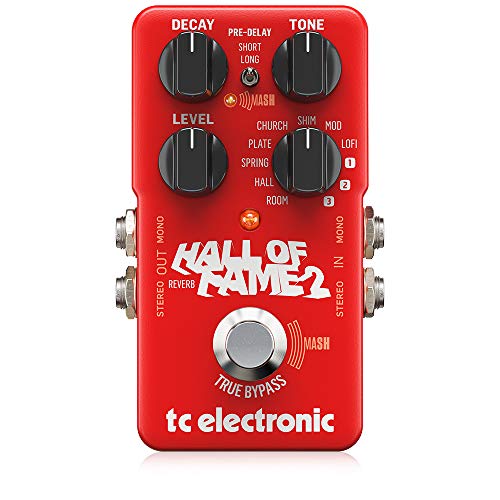
The TC Electronic Hall of Fame 2 is the reverb pedal for players who want one box that covers small rooms, big halls, spring sparkle, and shimmer. It offers eight reverb modes plus three TonePrint slots that can hold artist-made sounds loaded from a phone app. The MASH footswitch adds a twist: pressing it harder changes the reverb in real time, working a little like an expression pedal built into the switch.
For clean playing, a little hall or plate reverb makes a practice amp sound larger and more polished. For ambient playing, the shimmer mode adds a high, singing layer above the notes. The pedal has true bypass, so the dry signal passes through untouched when the effect is off. One count to be aware of: some roundups describe the pedal as having ten reverb types, while the maker lists eight modes plus the TonePrint slots.
Specs
| Specification | Detail |
|---|---|
| Brand | TC Electronic |
| Model | Hall of Fame 2 |
| Effect | Reverb |
| Reverb modes | 8, plus 3 TonePrint slots |
| Footswitch | MASH, pressure-sensitive |
| Bypass | True bypass |
| Power | 9 volts DC, 100 milliamps |
| Dimensions | 5 x 3.5 x 3 inches |
| Weight | 12.3 oz |
How to choose
Start with the job, not the brand. If the guitar drifts out of tune during practice, the tuner comes first. If the amp already has a drive channel and the player wants a different flavor of grit, an overdrive is the next step. If the amp is clean and the player wants heavy rhythm tones, a distortion makes more sense. Delay and reverb are the last two to add, because they shape the sound rather than create it.
Check power before buying a second or third pedal. Every pedal in this guide runs on 9 volts, but their current draws differ, and a daisy-chain supply has a limit. The tuner can pass power to other BOSS pedals, which helps on a small board. Count the knobs, too: three-knob pedals are easier to learn on than pedals with deep menus, and every pedal here has three or four main controls.
Finally, think about the order the pedals will sit in. The usual chain is tuner first, then overdrive, then distortion, then delay, then reverb last. That order keeps the tuner reading a clean signal and lets the delay and reverb work on the finished drive sound.
Who should skip
Players who only play acoustic guitar should skip this whole group, since these pedals are built for electric guitar signals and need an amp to shine. Players who already own a multi-effects unit should also pause: a multi-effects box covers tuner, drive, delay, and reverb in one unit, and buying single pedals only makes sense once a favorite sound is worth owning on its own.
Anyone who plays only through headphones with a phone app should check compatibility first. These pedals need a real amplifier or an amp simulator with an input jack to work. And players chasing one very specific vintage sound should not expect a first pedal to deliver it exactly; the pedals here are versatile starting points, not replicas of rare originals.
Frequently Asked Questions
How many pedals does a beginner need to start?
One tuner and one drive pedal are enough to start. The tuner keeps practice honest, and the drive pedal shows what effects do to the sound. Add delay or reverb once the first two feel natural, rather than buying five pedals at once and learning none of them well.
Do guitar pedals need a power supply, or do they run on batteries?
Every pedal in this guide runs on a 9-volt battery or a 9-volt DC adapter. Batteries are fine for practice, but an adapter is cheaper over time and avoids a battery dying mid-song. A daisy-chain cable can power several pedals from one adapter if the total current draw fits within the adapter limit.
What order should the pedals go in?
Put the tuner first, then overdrive, then distortion, then delay, then reverb last. The tuner reads the cleanest signal at the front, the drives shape the tone in the middle, and the delay and reverb add space at the end. Try other orders later, since moving the delay before the distortion changes the sound in interesting ways.
Will these pedals work with a bass guitar?
The tuner works with bass, since it has a dedicated Bass mode. The drive, delay, and reverb pedals are voiced for guitar and can thin out the low end on bass, so bass players should look at bass-specific versions instead. The BOSS TU-3 is the only pick here that suits both instruments equally.
Final verdict
For most beginners, the BOSS TU-3 tuner and the BOSS SD-1 overdrive are the two pedals to buy first. They solve the two problems every new player faces: staying in tune and getting a satisfying drive sound from a clean amp. The BOSS DS-1 adds heavier distortion when the player is ready for it, while the MXR Carbon Copy delay and the TC Electronic Hall of Fame 2 reverb add the space and depth that make practice feel like playing.
More from Amazon
Programs that pair well with the guide above. Offers and eligibility are set by Amazon and may change.
Free shipping on eligible items, Prime Video and more. Eligible new members can start with a free trial.
Start a Prime free trialAudiobooks and podcasts to listen to on the go. Eligible new members can start with a free trial.
Try Audible freeAd-free music streaming. Eligible new subscribers can start with a free trial.
Try Music Unlimited freeA free business account with business pricing and bulk-buying tools for work, shop or home office.
Create a business accountAs an Amazon Associate we earn from qualifying purchases.



Write Your Review
No reviews yet. Be the first to share your experience!