

Key takeaways
- Five bass guitar amps for practice and small gigs compared, from 25-watt combos to a battery-powered stereo pack, with tone and volume guidance.
- Top Pick: Fender Rumble LT25
- Runner-up: Fender Rumble 40
- Also consider: Orange Crush Bass 25
A bass guitar amp for practice has a different job from a stage rig. It needs to sound full at low volume, fit in a bedroom corner, and let you hear every note clearly without shaking the walls. For small gigs, it needs enough clean headroom to sit beside an acoustic guitar or a quiet drummer without distorting.
This guide compares five bass guitar amps built for practice and small gigs.
As an Amazon Associate, we earn from qualifying purchases.
Quick answer
For most players, the Fender Rumble 40 is the best balance of power and portability, with 40 watts and a 10-inch speaker that handles small gigs. The Fender Rumble LT25 adds amp models and effects, while the Orange Crush Bass 25 brings warm analog tone. The Ampeg Rocket Bass RB-108 covers classic tone, and the Blackstar Fly 3 Bass Stereo Pack is the travel pick.
Fender Rumble LT25

The Fender Rumble LT25 is the practice amp for players who like to explore sounds. It packs 50 presets built from 15 amp models and 20 effects into a compact 25-watt combo, so a beginner can try clean, overdriven, and effected tones without buying pedals.
The amp itself is a straightforward 25-watt combo with a single 8-inch speaker. That is enough volume for a bedroom, a lesson room, or a quiet jam, and the headphone output covers late-night practice. An aux input lets you play along with tracks from a phone or laptop, which turns scale exercises into something closer to playing with a band.
The trade-off is complexity. Players who want a single good tone with three knobs may find the preset menu more than they need, and the modeling features add little at a gig where a simple clean tone wins. For home practice, though, the LT25 keeps things interesting, and that matters when the goal is to play every day.
Specs: 25-watt combo; 1 x 8 inch speaker; 50 presets; 15 amp models; 20 effects; built-in tuner; aux input; headphone output; model 2270100000; ASIN B07N2897CX.
Fender Rumble 40

The Fender Rumble 40 is the most versatile amp in this guide, and the one most likely to cover both practice and small gigs. Forty watts through a 10-inch speaker gives enough clean volume for a coffeehouse set, a rehearsal with a quiet drummer, or a worship band, while the amp still weighs little enough to carry in one hand. A four-band EQ shapes the tone precisely, and the overdrive circuit adds grit when a song calls for it.
The extra features are practical rather than decorative. An XLR line output sends the signal to a PA system or a recorder, which extends the amp far beyond its own speaker at larger gigs. The aux input and headphone output cover silent practice, and the ported cabinet helps the low end stay full at modest volume.
The Rumble 40 is also the pick for players who plan to grow. Its power and connections suit a first band, a school ensemble, or a regular small-venue gig, and it remains useful as a practice amp long after a bigger rig arrives. For most buyers in this guide, it is the right single purchase.
Specs: 40-watt combo; 1 x 10 inch Fender Special Design speaker; 4-band EQ; overdrive circuit with gain and blend; XLR line out; aux input; headphone output; model 2370300000; ASIN B00HWINMR6.
Orange Crush Bass 25
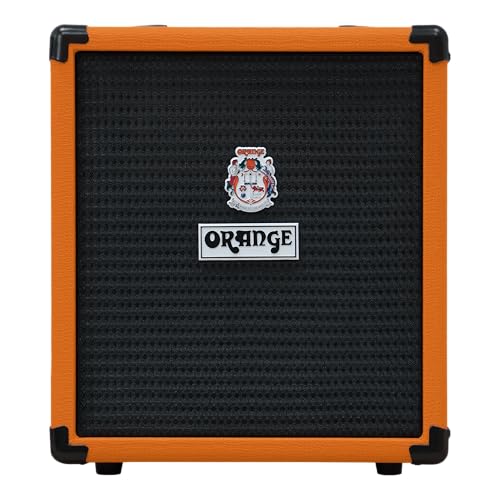
The Orange Crush Bass 25 brings the warm, rounded character Orange is known for into a compact practice combo. Its all-analog signal path gives a natural feel that digital modeling sometimes misses, and the active EQ with a parametric mid control lets you shape the tone precisely. A chromatic tuner sits on the front panel, and the CabSim headphone output emulates a speaker cabinet for quiet practice that still sounds full.
The 25-watt output and 8-inch speaker suit a bedroom, a lesson room, or a small rehearsal, and the ported cabinet helps the low end punch above its size. An aux input lets you play along with backing tracks, which makes practice sessions more musical.
The Crush Bass 25 costs more than some rivals with similar wattage, and its analog design means no built-in effects or presets. Players who want modeling variety should look at the Rumble LT25 instead. For those who value a single warm, honest tone and a well-built box, the Orange earns its place.
Specs: 25-watt combo; 1 x 8 inch speaker; all-analog signal path; active 3-band EQ with parametric mid; chromatic tuner; CabSim headphone output; aux input; ported cabinet; ASIN B01HONIONA.
Ampeg Rocket Bass RB-108

The Ampeg Rocket Bass RB-108 carries the classic Ampeg voice into a small, light combo. Its Legacy preamp and 3-band EQ deliver the warm, round tone that has defined Ampeg bass sound for decades, and the Super Grit Technology overdrive adds a gutsy growl when a song needs edge. Thirty watts through a custom 8-inch speaker gives enough volume for practice and small rooms without overwhelming the space.
The RB-108 is also one of the lightest amps in this guide, which matters for players who carry their gear to lessons, rehearsals, and gigs. An aux input and headphone output cover silent practice, and the controls are simple enough for a beginner to learn in one session.
The main limitation is the absence of a direct output, so the RB-108 cannot feed a PA system the way the Rumble 40 can. That makes it a practice and small-room amp rather than a gigging amp for larger stages. For players who want classic Ampeg tone in a portable box, it is an easy recommendation.
Specs: 30-watt combo; 1 x 8 inch custom Lavoce speaker; Legacy preamp; 3-band EQ with Ultra Hi and Ultra Lo; Super Grit Technology overdrive; aux input; headphone output; model AMG RB108; ASIN B08TGGLP6V.
Blackstar Fly 3 Bass Stereo Pack

The Blackstar Fly 3 Bass Stereo Pack is the travel amp of this guide, and the smallest by a wide margin. It pairs the 3-watt Fly 3 Bass mini amp with the Fly 103 extension cabinet and a power supply, creating a 6-watt stereo setup that fits in a gig bag side pocket. Two channels cover clean and overdriven tones, and a compressor, Sub bass control, and mid-cut EQ shape the sound far beyond what the size suggests.
Battery power is the key feature. Six AA batteries run the amp for hours, so it works in a park, a car, or a hotel room with no outlet in sight. An MP3 and line input lets you jam along with tracks, and the emulated line output doubles as a headphone jack for silent practice or a direct feed for recording.
Three watts per side cannot compete with a drummer, so this is a practice and travel tool rather than a gig amp. But for a bassist who practices on the move, sketches ideas away from home, or needs a silent rig for late nights, the Stereo Pack is the most portable option in this guide, and the extension cabinet makes it sound bigger than its size.
Specs: 6-watt stereo pack (3W amp plus 3W extension cabinet); 2 x 3 inch full-range speakers; 2 channels, clean and overdrive; compressor; Sub bass; mid-cut EQ; MP3/line in; emulated line out and headphone jack; battery or power supply; model FLY3BASSPAK; ASIN B01EMSREDG.
How to choose a bass guitar amp for practice and small gigs
Wattage and speaker size decide how loud the amp plays cleanly. For bedroom practice, 10 to 25 watts through a 6.5 or 8-inch speaker is plenty, and a headphone output matters more than raw power. For small gigs with a quiet drummer, look for 30 to 40 watts and a 10-inch speaker, which moves enough air to be heard without distortion.
Tone controls shape the sound more than wattage does. A three or four-band EQ lets you cut mud or add punch, while an overdrive circuit adds grit for rock. Choose the feature set that matches how you practice, not the longest spec sheet.
Check the connections. An aux input lets you play along with backing tracks, a headphone output enables silent practice, and an XLR line output extends the amp to a PA system at larger gigs. Weight matters too: an amp you carry to every rehearsal should be light enough to carry in one hand with the bass in the other.
Finally, play the amp with your own bass if you can. Different basses interact with different amps, and a quick test reveals whether the low end stays tight or turns muddy. If a test is not possible, choose the amp whose speaker size and wattage match the rooms you play in most.
Who should skip these bass guitar amps
Skip this guide if you play in a loud rock or metal band with a heavy-handed drummer, because 25 to 40 watts cannot keep up with a full drum kit and loud guitars. Look for a 100-watt combo or a separate head and cabinet instead, and plan for the weight and cost that come with stage volume.
Skip it as well if you only need a headphone practice tool, since a pocket headphone amp or a multi-effects pedal with a headphone output costs less and fits in a case pocket. A combo amp adds a speaker you may never use.
Players who record seriously should also consider a direct recording interface alongside any of these amps, because a microphone on a small speaker captures room noise that a direct signal avoids. The amps here are practice and small-gig tools first, and recording tools second.
Frequently asked questions
How many watts do I need for bass practice at home?
Ten to 25 watts is enough for home practice, because bass frequencies carry well at low volume and a headphone output covers late nights.
Can a 25-watt bass amp handle a small gig?
A 25-watt combo suits a coffeehouse, a quiet rehearsal, or an acoustic setting, especially with a 10-inch speaker. It struggles beside a loud drummer, so for small gigs with drums, the 40-watt Rumble 40 or a line output to the PA system is the safer choice.
Do I need a bigger speaker for a five-string bass?
A five-string bass reaches lower notes that challenge small speakers, so a 10-inch speaker handles the low B better than an 8-inch one. The Rumble 40 is the pick here for five-string players, and a larger cabinet is worth considering if the low end sounds muddy.
What is the difference between a combo amp and a head and cabinet?
A combo amp puts the amplifier and speaker in one box, which is portable and simple. A head and cabinet separate them, which allows more power and speaker choices but costs more and weighs more. For practice and small gigs, a combo is the practical choice.
Final verdict
The Fender Rumble 40 is the best single purchase for most players, because 40 watts and a 10-inch speaker cover practice, rehearsal, and small gigs, and the XLR output extends it to larger stages. The Fender Rumble LT25 is the practice pick for players who enjoy amp models and effects, while the Orange Crush Bass 25 suits those who want warm analog tone.
Choose the Ampeg Rocket Bass RB-108 for classic tone in the lightest box here, and take the Blackstar Fly 3 Bass Stereo Pack when the amp needs to travel anywhere. Confirm the exact model before ordering.
More from Amazon
Programs that pair well with the guide above. Offers and eligibility are set by Amazon and may change.
Free shipping on eligible items, Prime Video and more. Eligible new members can start with a free trial.
Start a Prime free trialAudiobooks and podcasts to listen to on the go. Eligible new members can start with a free trial.
Try Audible freeAd-free music streaming. Eligible new subscribers can start with a free trial.
Try Music Unlimited freeA free business account with business pricing and bulk-buying tools for work, shop or home office.
Create a business accountAs an Amazon Associate we earn from qualifying purchases.



Write Your Review
No reviews yet. Be the first to share your experience!