

Key takeaways
- Tap out rhythms with the best kids cajons, from compact box drums to junior percussion sets made for music lessons, classrooms and family jam sessions.
A cajon is one of the simplest ways for a child to learn rhythm: sit down, tap the front, and the box answers with bass and slap. No sticks, no pedals, no tuning — just hands on wood. For a first drum, that direct connection matters more than anything else, because a child who can make a good sound in the first minute will come back for the second.
The hard part is size. A full box is about 19 inches tall, and a younger child sitting on one often cannot reach the floor with both feet, which makes playing awkward and tiring. The five cajons below are all compact enough for a child to play comfortably — four sit-on boxes and pads, plus one lap-played option — and each one carries a real Amazon listing with a verified code.
Quick Picks
As an Amazon Associate we earn from qualifying purchases
| Product | Best for | Key spec from title |
|---|---|---|
| Meinl Jam Cajon | First sit-on box drum | Baltic birch, 10.25 x 10.25 x 15 inches |
| GECKO Travel Cajon | Travel and lap playing | Zebrawood pad, 11.42 x 9.25 x 1.77 inches |
| Sawtooth Harmony Series Compact Cajon | Compact sit-on drum with a hand-stained finish | Model ST-SSC-C, satin black finish |
| POGOLAB Travel Cajon | Lightweight travel drum | Octagonal wood body, 2.6 lb |
| Meinl Pickup Turbo Slaptop Cajon | Lap playing with a built-in pickup | Walnut surface, forward sound ports |
How to Choose
Size and seat height
A child should sit on a cajon the way an adult sits on a chair: both feet flat on the floor, knees bent at a comfortable angle, hands reaching the playing surface without leaning far forward. If the box is too tall, the child slides forward, the feet dangle, and the bass tone suffers because the body cannot brace against the box. Compact boxes around 15 inches tall suit most children from about age six upward, while smaller players do better with a lap pad or a lap-played cajon that removes seat height from the equation entirely. Measure the child sitting on a dining chair first: if the knees sit well above the hips, the box is too tall.
Snare sound and tone
A cajon makes two main sounds: a deep bass note from the center of the playing surface and a sharp slap near the top edge. Snare wires inside the box add a crisp buzz to the slap, which gives it the crack of a drum kit. Fixed snares are the simplest choice for a first cajon because there is nothing to adjust and nothing to come loose. Adjustable snares give more control, but they add parts a young player may fiddle with instead of playing. Listen for a clean split between bass and slap: if both sounds blur together, the box will feel dull.
Weight and portability
A first cajon travels a lot: to lessons, to school, to a grandparent’s house. A box under about seven pounds is easy for a child to carry with one hand, while a heavier box needs an adult to move it. Flat travel pads and lap cajons are the easiest of all to carry because they slip into a backpack or a tote bag, and several below include a bag or a strap. Birch is the common wood here: a good balance of weight and tone, and it holds up well to daily knocks. Avoid boxes that feel flimsy at the corners: a cajon that flexes under a child will not last the year.
Lap-played or sit-on
Most cajons are sit-on boxes, the classic way to play. A lap-played cajon flips that around — the instrument rests across the knees and the playing surface faces up and forward, which suits younger children and anyone who finds sitting on a tall box uncomfortable. Lap cajons also suit a classroom where chairs are shared and floor space is tight. The trade-off is bass depth: a lap cajon has less internal volume than a sit-on box, so its low notes are lighter. For a first instrument, either style works; pick the one the child reaches for without being asked.
The 5 Best Options
Meinl Jam Cajon

The Meinl Jam Cajon is the compact box that anchors this guide, and it earns that place by being the right size for a child without feeling like a toy. At 15 inches tall it lets a younger player sit with both feet on the floor, and the Baltic birch body gives a full, resonant bass note with a crisp slap at the top corners. Two sets of fixed snare wires sit inside the box, so the snare sound is always there and never needs adjusting. Meinl builds this cajon in Europe, and the 2-year warranty is a useful sign of how long the maker expects it to last.
Specs
- Baltic birch body and playing surface
- Fixed internal snare wires, two sets
- 10.25 x 10.25 x 15 inches
- Model JC50LBNT
- 2-year Meinl warranty
Best for: A first sit-on box drum for a child learning rhythm at home or in lessons.
Watch out for: The compact height suits smaller players; a tall teenager may prefer a full-size box.
ASIN: B00PNG4AWA
GECKO Travel Cajon
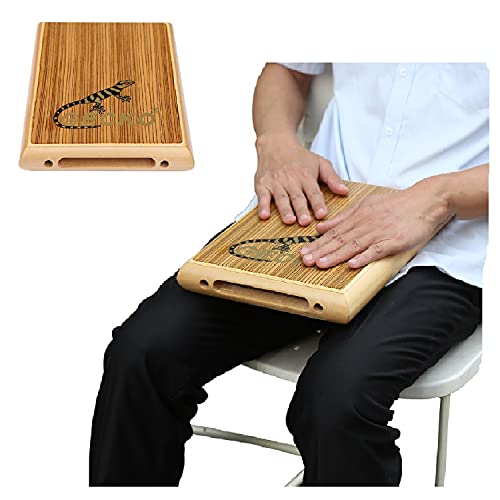
The GECKO Travel Cajon is not a box at all: it is a flat zebrawood pad that plays like a cajon and packs like a book. Internal guitar strings give it a bright snare crack, and the pad is light enough at 2.75 pounds for a child to carry in a backpack — the listing includes one. It works best for rhythm practice, travel, and quiet sessions, since the thin body cannot move as much air as a full box and the bass note stays light. For a child who already has a sit-on cajon, this is the second instrument that goes everywhere the first one cannot.
Specs
- Zebrawood playing surface
- Internal guitar strings
- 11.42 x 9.25 x 1.77 inches
- 2.75 pounds
- Backpack included
- Model PAD2
Best for: Travel, practice, and lap playing when a full box is too much to carry.
Watch out for: The bass tone is lighter than a sit-on box, so it suits practice more than performance.
ASIN: B08ZND7PN3
Sawtooth Harmony Series Compact Cajon

The Sawtooth Harmony Series Compact Cajon is a small sit-on box with a hand-stained Spirit design in satin black, and it is the most traditional-looking cajon in this guide. Its compact frame suits a child who wants a real box drum rather than a pad, and the Harmony Series build keeps the weight down so the box is easy to move between rooms. The satin finish shows fingerprints less than a glossy one, which is a small mercy with young hands. It is a straightforward choice: a compact box, a clear bass note, and no extras to lose.
Specs
- Hand-stained Spirit design, satin black finish
- Compact Cajon, Harmony Series
- Model ST-SSC-C
- UPC 811501069874
Best for: A child who wants a traditional sit-on box drum in a compact frame.
Watch out for: The compact body gives a lighter bass note than a full-size box.
ASIN: B01L3RKEY0
POGOLAB Travel Cajon

The POGOLAB Travel Cajon takes a different shape from every other cajon here: an octagonal wooden body that is easy to hold and hard to confuse with a plain box. At 2.6 pounds it is one of the lightest cajons in this guide, and the adjustable strap makes it simple for a child to carry to a lesson or a friend’s house. The octagonal form gives several flat playing faces, so a young player can find the sound they like by turning the drum. It is a travel drum first and a sit-on box second, and it is happiest in a classroom, a car, or a park.
Specs
- Octagonal wooden travel body
- Adjustable strap included
- 2.6 pounds
- Model M0-2686
Best for: A light travel drum for lessons, classrooms, and outdoor play.
Watch out for: The octagonal body is smaller than a sit-on box, so the bass note is modest.
ASIN: B0BZD3F72F
Meinl Pickup Turbo Slaptop Cajon

The Meinl Pickup Turbo Slaptop Cajon is the lap-played option in this guide, and it solves the size problem differently: the child holds it across the knees and plays a surface that faces up and forward. A built-in pickup with bass, snare, and tone controls lets the cajon plug into an amplifier or a PA, which suits a child who plays with others and wants to be heard. The walnut playing surface has fixed internal snares, and forward-facing sound ports push the sound toward the audience. It is the most grown-up instrument here, and one a child will not outgrow quickly.
Specs
- Walnut playing surface
- Built-in pickup
- Internal snares
- Forward-projecting sound ports
- 18.5 x 14.25 x 9.5 inches
- Model PTOPCAJ2WN
- 2-year warranty
Best for: Lap playing and plugging into an amplifier for group sessions.
Watch out for: It is a lap instrument, not a sit-on box, so it needs a chair and a steady lap.
ASIN: B079FXDFHF
Which One Fits Your Situation
A first drum for a young child
Pick the smallest instrument the child can play. For a child under about eight, a lap pad or a lap-played cajon removes the seat-height problem, and the GECKO pad or the Meinl Slaptop will feel natural at once. A child of eight or older who can sit flat-footed on a 15-inch box will get more bass and more fun from the Meinl Jam Cajon or the Sawtooth box. The goal is an instrument the child can pick up alone.
Lessons, school, and travel
If the cajon rides in a backpack or a car every week, weight and shape decide everything. The GECKO pad slips into a bag, the POGOLAB drum hangs from its strap, and both weigh under three pounds. A sit-on box works too if an adult carries it, but a child who has to lug a box to every lesson will leave it at home. For school lessons, a pad or a travel drum is the practical pick.
Playing with others and being heard
A child who plays with a guitar, a ukulele, or a small band needs volume and tone. The Meinl Slaptop is the only cajon here with a built-in pickup, so it plugs into an amplifier and holds its own in a group. The sit-on boxes can work in a group too, but their sound stays acoustic and unamplified, which suits a living room more than a hall. Match the cajon to the loudest room it will play in.
A small space or a quiet house
A cajon is a hand drum, so it is quieter than a kit, but a full box can fill a small room. The GECKO pad and the POGOLAB travel drum are the gentlest options here, with light bass notes that stay in the room. A sit-on box gives a deeper bass note, so it suits a house with space to play. If practice happens after bedtime for younger siblings, the pad is the kind choice.
Common Mistakes
- Buying a full-size box for a small child, then wondering why practice feels like a chore.
- Choosing by looks alone: a glossy finish says nothing about how the bass note sounds.
- Forgetting the carry: a cajon without a bag or a strap stays home more often than it travels.
- Ignoring the snare: a box with no snare wires sounds flat, and a child will lose interest fast.
- Treating a travel pad like a sit-on box: pads are for laps and tables, not for sitting on.
Frequently Asked Questions
What age is a cajon good for?
Most children can enjoy a cajon from about age five, as long as the instrument fits. A lap pad or a lap-played cajon suits a five- or six-year-old, while a compact sit-on box suits a child of eight or older who sits flat-footed on it. The key is comfort: if the child can reach the playing surface and the floor together, the size is right.
Does a child need lessons to play a cajon?
No. A cajon is one of the few instruments a child can play well by ear, tapping the center for bass and the top edge for slap. A few lessons help with rhythm patterns, and a teacher can correct a grip before it becomes a habit. Many children learn their first patterns in family jam sessions and school music classes, then take lessons later if they want more.
How loud is a kids cajon?
A cajon is much quieter than a drum kit, and a travel pad is quieter still. A sit-on box played with open hands fills a living room without shaking the walls, which is why cajons are popular for home practice. For late-evening sessions, a pad or a light touch keeps the volume down, and a rug under the box softens the bass note further.
What should a child play along with?
Simple songs with a steady beat are the best place to begin: folk tunes, pop songs, and classroom rhythm games all work well. A cajon pairs naturally with an acoustic guitar, a ukulele, or a voice, since it adds rhythm without covering the melody. Once the child can hold a steady beat for a whole song, try playing along with a metronome or a backing track.
More from Amazon
Programs that pair well with the guide above. Offers and eligibility are set by Amazon and may change.
Free shipping on eligible items, Prime Video and more. Eligible new members can start with a free trial.
Start a Prime free trialAudiobooks and podcasts to listen to on the go. Eligible new members can start with a free trial.
Try Audible freeAd-free music streaming. Eligible new subscribers can start with a free trial.
Try Music Unlimited freeA free business account with business pricing and bulk-buying tools for work, shop or home office.
Create a business accountAs an Amazon Associate we earn from qualifying purchases.






Write Your Review
No reviews yet. Be the first to share your experience!